


Available courses
- Teacher: Tai-Ping Chen
- Teacher: tzu chi teacher
- Teacher: Mina Ting
- Teacher: Tracy Wang
- Teacher: Jenny Chu
- Teacher: tzu chi teacher
- Teacher: Mina Ting
- Teacher: Tracy Wang
- Teacher: Joanna Chien
- Teacher: Yong Ping Li
- Teacher: tzu chi teacher
- Teacher: Mina Ting
- Teacher: Tracy Wang
- Teacher: wei ling
- Teacher: tzu chi teacher
- Teacher: Mina Ting
- Teacher: Tracy Wang
- Teacher: tzu chi teacher
- Teacher: Mina Ting
- Teacher: Tracy Wang
- Teacher: Joanna Chien
- Teacher: Yong Ping Li
- Teacher: tzu chi teacher
- Teacher: Mina Ting
- Teacher: Tracy Wang
- Teacher: Jenny Zhuang
- Teacher: tzu chi teacher
- Teacher: Mina Ting
- Teacher: Tracy Wang
- Teacher: tzu chi teacher
- Teacher: Mina Ting
- Teacher: Tracy Wang
Thanksgiving is often a time to get together with loved ones and share what we are grateful for. To celebrate the joy together, Hawaii Tzu Chi Academy would like to invite you and your family to our Thanksgiving. During the event, students will offer tea and give massage to their parents. By hosting this event, we hope to cultivate students' attitude of gratitude, respect and love. To make this event meaningful to your kids, your participation is very important..
感恩節是與家人朋友相聚,並向身邊的人表達感恩的日子。本校誠邀您和您的家人參加感恩節茶會,希望由活動中,學生能體會感恩,尊重,愛。活動當天,學生將會奉茶給家長以及為家長按摩,這是一個很好與您孩子互動的機會,希望您能抽空參與。
- Teacher: Connie R Chang
- Teacher: Connie123 Chang
- Teacher: Tai-Ping Chen
- Teacher: Joanna Chien
- Teacher: Jenny Chu
- Teacher: Yong Ping Li
- Teacher: wei ling
- Teacher: Teacher Test
- Teacher: Mina Ting
- Teacher: Tracy Wang
- Teacher: Jenny Zhuang
- Teacher: Connie123 Chang
|
什麼是慈濟人文?為何要強調慈濟人文? |
|
|
|
上人的回答: |
|
|
|
人文就是人格價值的精華。若大家皆有共同的理念,在慈濟團體裡,不論士、農、工、商,人人皆平等,不分高低;慈濟人活動時必著制服,全球一致無分別。全球的慈濟人都說,這一套藍天白雲,是他們能受人肯定與稱讚的國際品牌。 |
傳承法脈環保清淨在源頭
弘揚宗門落實環保七化
The objectives of the training :
1. How to login the Moodle
2. Update the profile
3. Create/Layout New Courses
4. Create the Quiz
- Teacher: Connie Chang
- Teacher: Tai-Ping Chen
- Teacher: Joanna Chien
- Teacher: Jenny Chu
- Teacher: Yong Ping Li
- Teacher: wei ling
- Teacher: tzu chi teacher
- Teacher: Jenny Zhuang
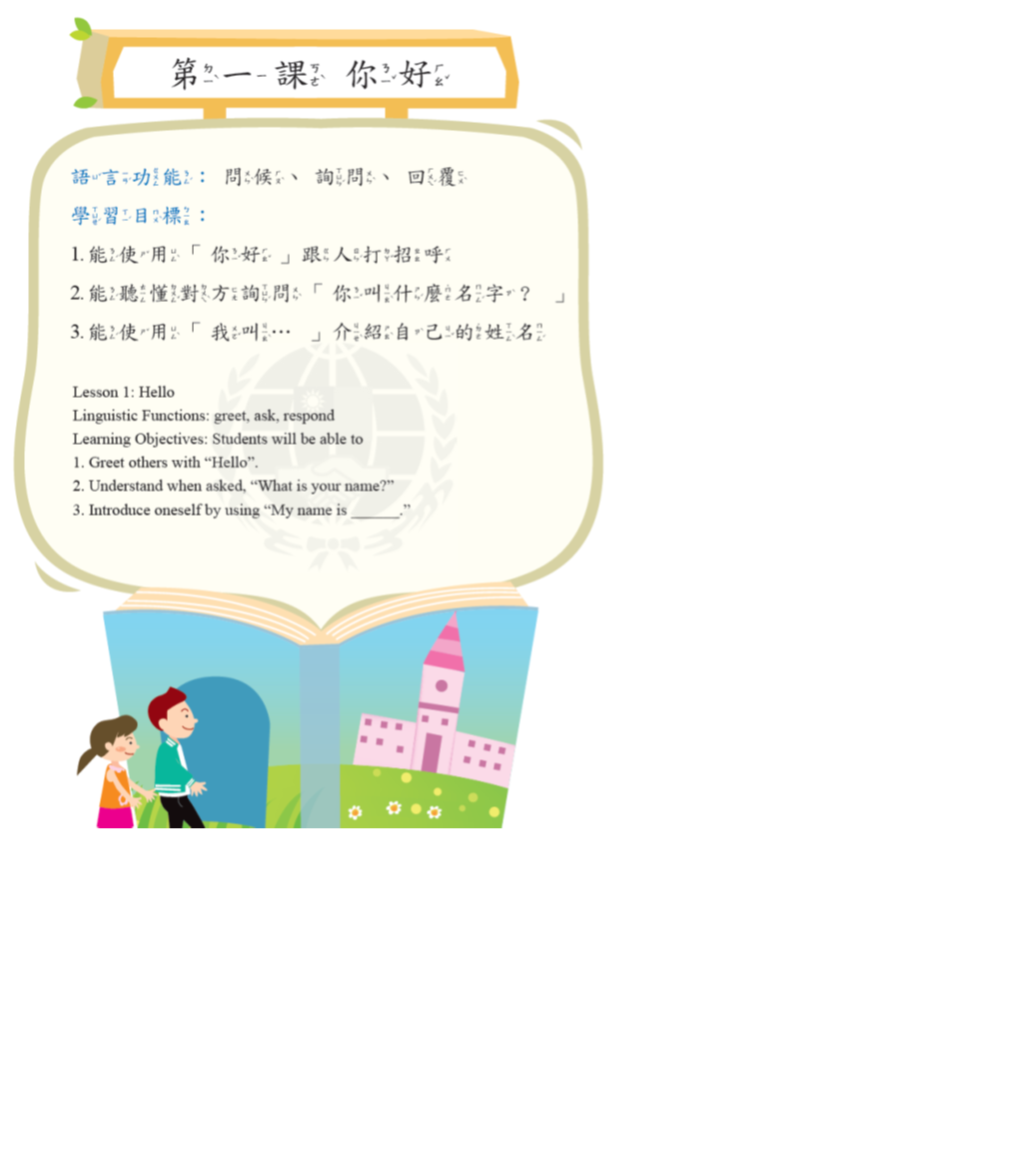
語言功能:問候、介紹、詢問
學習目標:
1. 能使用「你好」跟人打招呼
2. 能聽懂對方詢問「你叫什麼名字?」
3. 能使用「我叫…」介紹自己的姓名
Linguistic Functions: greet, introduce, ask
Learning Objectives: Students will be able to
1. Greet others with “Hello”
2. Understand when asked, “What is your name?”
3. Introduce oneself by using “My name is ______.”
- Teacher: Tai-Ping Chen
- Teacher: Joanna Chien
- Teacher: Jenny Chu
- Teacher: Yong Ping Li
- Teacher: wei ling
- Teacher: Mina Ting
- Teacher: Tracy Wang
- Teacher: Jenny Zhuang
語言功能:詢問、回覆、敘述、數詞(1~5)
學習目標:
1. 能聽懂詢問家庭成員數量
2. 會使用疑問詞「呢?」和「幾」、量詞
「個」
3. 能說出家庭成員稱謂
4. 能說出數字一~五
Lesson 2: How many people are there in your family?
Linguistic Functions: ask, respond, tell, numerals(1~5)
Learning Objectives: Students will be able to
1. Understand when asked how many people there are in his/her family.
2. Use question words and quantifiers.
3. Name the members of a family.
4. Say the numbers one to five.
- Teacher: Tai-Ping Chen
- Teacher: Joanna Chien
- Teacher: Jenny Chu
- Teacher: Yong Ping Li
- Teacher: wei ling
- Teacher: Mina Ting
- Teacher: Tracy Wang
- Teacher: Jenny Zhuang
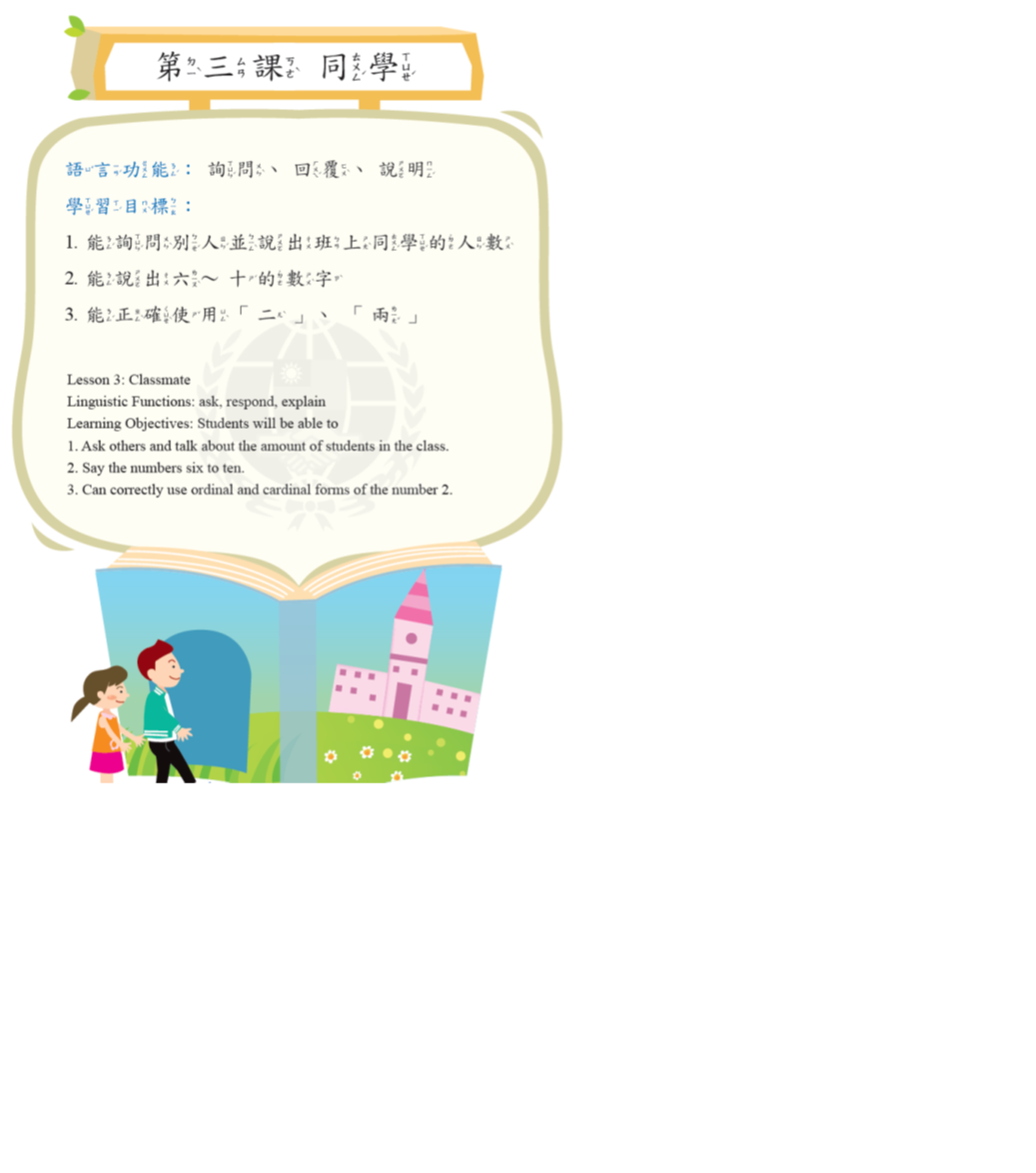
語言功能:詢問、回覆、數詞(6~10)
學習目標:
1. 能詢問別人並說出班上同學的人數
2. 能學會在量詞前需使用「兩」
3. 能學會使用助詞「也」
4. 能說出六~十的數字
Linguistic Functions: ask, respond, numerals(6~10)
Learning Objectives: Students will be able to
1. Ask others and talk about the number of students in the class.
2. Use “two” before a quantified noun.
3. Use the conjunction “and also”.
4. Say the numbers six to ten.
- Teacher: Tai-Ping Chen
- Teacher: Joanna Chien
- Teacher: Jenny Chu
- Teacher: Yong Ping Li
- Teacher: wei ling
- Teacher: Mina Ting
- Teacher: Tracy Wang
- Teacher: Jenny Zhuang
學習目標:
1. 能說「牛奶、麵包、水果、果汁」等
部分食物和飲料的名稱
2. 能以「有什麼」來詢問
3. 能使用「還要」表達個人需求
4. 能使用「有…還有…」表達兩種以上的東西
Linguistic Functions: command, tell, choose, request
Learning Objectives: Students will be able to
1. Say “Milk, bread, fruit, juice” and other names of food and drinks.
2. Use “What do we have?” in a question.
3. Use “and also” to express personal needs.
4. Use “there is…and also…” to express two of the kinds of things above.
- Teacher: Tai-Ping Chen
- Teacher: Joanna Chien
- Teacher: Jenny Chu
- Teacher: Yong Ping Li
- Teacher: wei ling
- Teacher: Mina Ting
語言功能:話題接續、解釋、程度表達
學習目標:
1. 能使用「很」、「有一點」、「太…了」
表達程度的不同
2. 能說出「夏天」及「冬天」兩個季節名稱
3. 能使用「可是」表示不同的想法
4. 能使用「喜歡」及「不喜歡」表達好惡
Linguistic Functions: topic continuation, explain, levels of expression
Learning Objectives: Students will be able to
1. Use “very”, “a little” and “too…(completed action marker)” to express different
degrees.
2. Say the seasons, “summer” and “winter”.
3. Use “but” to express different opinions.
4. Use “like” and “dislike” to express good and bad.
- Teacher: Tai-Ping Chen
- Teacher: Joanna Chien
- Teacher: Jenny Chu
- Teacher: Yong Ping Li
- Teacher: wei ling
- Teacher: Mina Ting
- Teacher: Tracy Wang
- Teacher: Jenny Zhuang
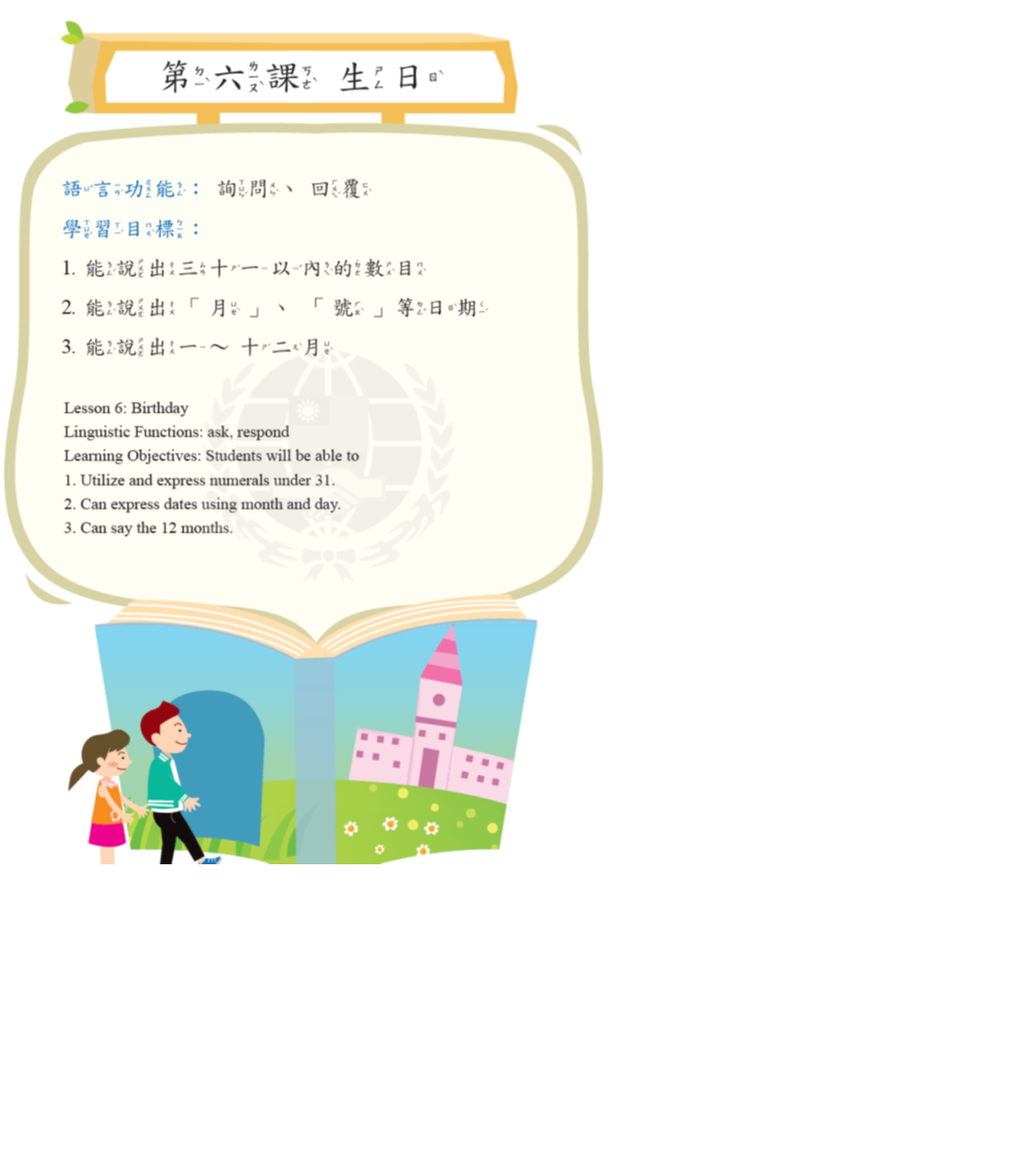
語言功能:邀請、詢問、數詞回覆
學習目標:
1. 能使用「快到了」表示時間即將接近
2. 能使用疑問詞「好不好」詢問他人意見
3. 能運用三十以內的數詞表達
4. 能詢問並說出自己喜歡的物品
Linguistic Functions: invite, ask, numeral response
Learning Objectives: Students will be able to
1. Use “almost here” to indicate the approach of time.
2. Use “all right?” in a question when asking for others’ opinions.
3. Utilize and express numbers up to 30.
4. Ask and talk about things they like.
- Teacher: Tai-Ping Chen
- Teacher: Joanna Chien
- Teacher: Jenny Chu
- Teacher: Yong Ping Li
- Teacher: Mina Ting
- Teacher: Tracy Wang
- Teacher: Jenny Zhuang
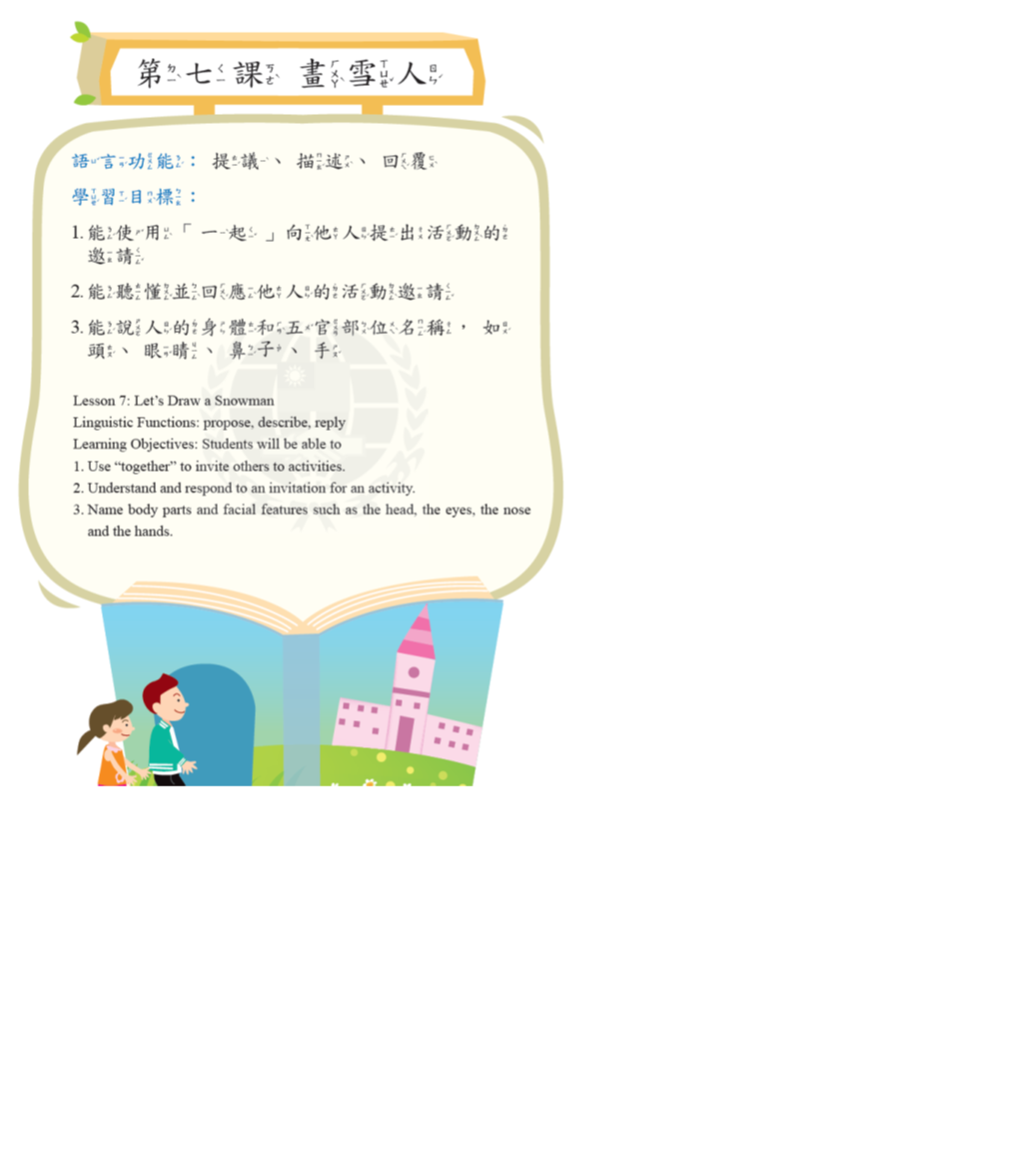
語言功能:話題接續、提議、描述、比較
學習目標:
1. 能使用「一起」向他人提出活動的邀請
2. 能聽懂並回應他人的活動邀請
3. 能說人的身體和五官部位名稱
4. 能比較身體和五官部位的大小程度差異
Linguistic Functions: topic continuation, propose, describe, compare
Learning Objectives: Students will be able to
1. Use “together” to invite others to activities.
2. Understand and respond to an invitation for an activity.
3. Name body parts and facial features.
4. Compare the size of body parts and facial features.
- Teacher: Tai-Ping Chen
- Teacher: Joanna Chien
- Teacher: Jenny Chu
- Teacher: Yong Ping Li
- Teacher: wei ling
- Teacher: Mina Ting
- Teacher: Tracy Wang
- Teacher: Jenny Zhuang
語言功能:詢問、回覆、敘述
學習目標:
1. 能詢問他人下課以後的活動
2. 能聽懂並說出自己的活動習慣
3. 能說出自己喜歡的休閒活動
4. 能表達自己對於運動、活動的看法與
習慣
Linguistic Functions: ask, respond, describe
Learning Objectives: Students will be able to
1. Ask others what they are doing after class.
2. Understand and talk about their own habits.
3. Talk about leisure activities that they enjoy.
4. Express their opinions about sports activities and habits.
- Teacher: Tai-Ping Chen
- Teacher: Joanna Chien
- Teacher: Jenny Chu
- Teacher: Yong Ping Li
- Teacher: wei ling
- Teacher: Mina Ting
- Teacher: Tracy Wang
- Teacher: Jenny Zhuang
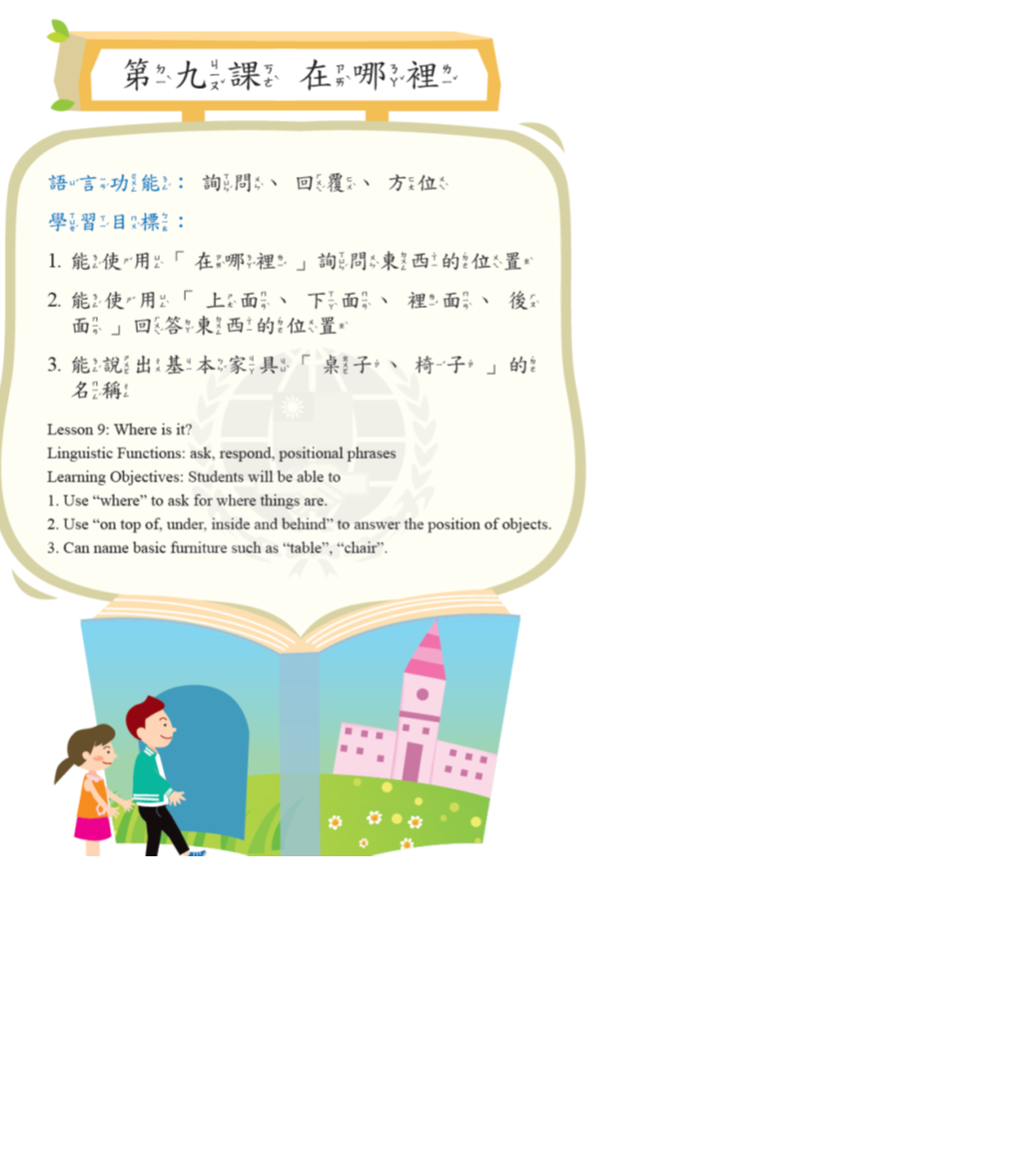
語言功能:詢問、回覆、方位
學習目標:
1. 能使用「在哪裡」詢問東西的位置
2. 能使用「上面、下面、裡面、後面」回
答東西的位置
3. 能說出基本家具「桌子、沙發」的名稱
4. 能使用「V 一下」表進行短暫的動作
Linguistic Functions: Ask, Respond, Positional Phrases
Learning Objectives: Students will be able to
1. Use “where” to ask for where things are.
2. Use “on top of, under, inside and behind” to describe the positions of objects.
3. Name basic furniture such as “table” and “sofa”.
4. Use “V–一下” to indicate a momentary action.
- Teacher: Tai-Ping Chen
- Teacher: Joanna Chien
- Teacher: Jenny Chu
- Teacher: Yong Ping Li
- Teacher: wei ling
- Teacher: Mina Ting
- Teacher: Tracy Wang
- Teacher: Jenny Zhuang
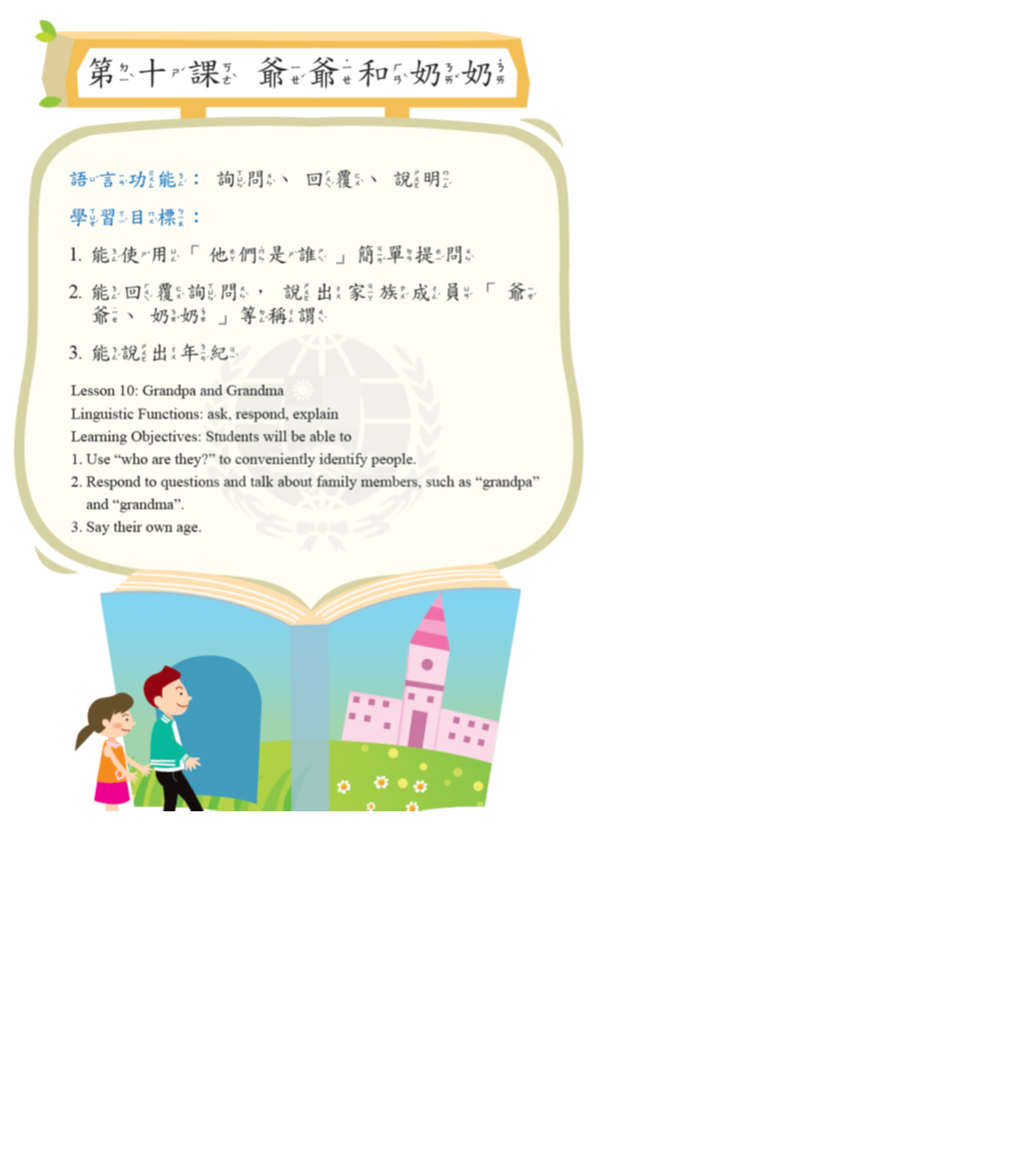
語言功能:詢問、回覆、方位
學習目標:
1. 能使用「他們是誰」簡單提問關於人
物身份
2. 能說出方位詞「中間、右邊、左邊」
3. 能回覆詢問,說出家族成員「爺爺、
奶奶、姑姑、叔叔」等稱謂
4. 能說出自己的年紀
Linguistic Functions: Ask, Respond, Positional Phrases
Learning Objectives: Students will be able to
1. Use “who are they?” to conveniently identify people.
2. Say positional phrases such as “in the middle/between”, “to the right”, “to the left”.
3. Respond to questions and talk about family members, e.g. “grandpa”, “grandma”,
“aunt”, and “uncle”.
4. Say their own age.
- Teacher: Tai-Ping Chen
- Teacher: Joanna Chien
- Teacher: Jenny Chu
- Teacher: Yong Ping Li
- Teacher: wei ling
- Teacher: Mina Ting
- Teacher: Tracy Wang
- Teacher: Jenny Zhuang
語言功能:解釋、接續話題、建議、方法
學習目標:
1. 能使用「怎麼去」詢問他人的交通方式
2. 能說出基本交通方式「開車、騎自行
車、走路」
3. 能使用「我想」表達個人的意願
4. 能表達選擇交通方式的簡單原因
Linguistic Functions: Explain, Topic Continuation, Suggestion, Method
Learning Objectives: Students will be able to
1. Use “how to get to” to inquire about means of transport.
2. Talk about basic transportation methods such as “driving”, “bicycling”, and
“walking”.
3. Use “I wish/I want” to express personal desires.
4. Express a simple choice of transportation methods.
- Teacher: Tai-Ping Chen
- Teacher: Joanna Chien
- Teacher: Jenny Chu
- Teacher: Yong Ping Li
- Teacher: wei ling
- Teacher: Mina Ting
- Teacher: Tracy Wang
- Teacher: Jenny Zhuang
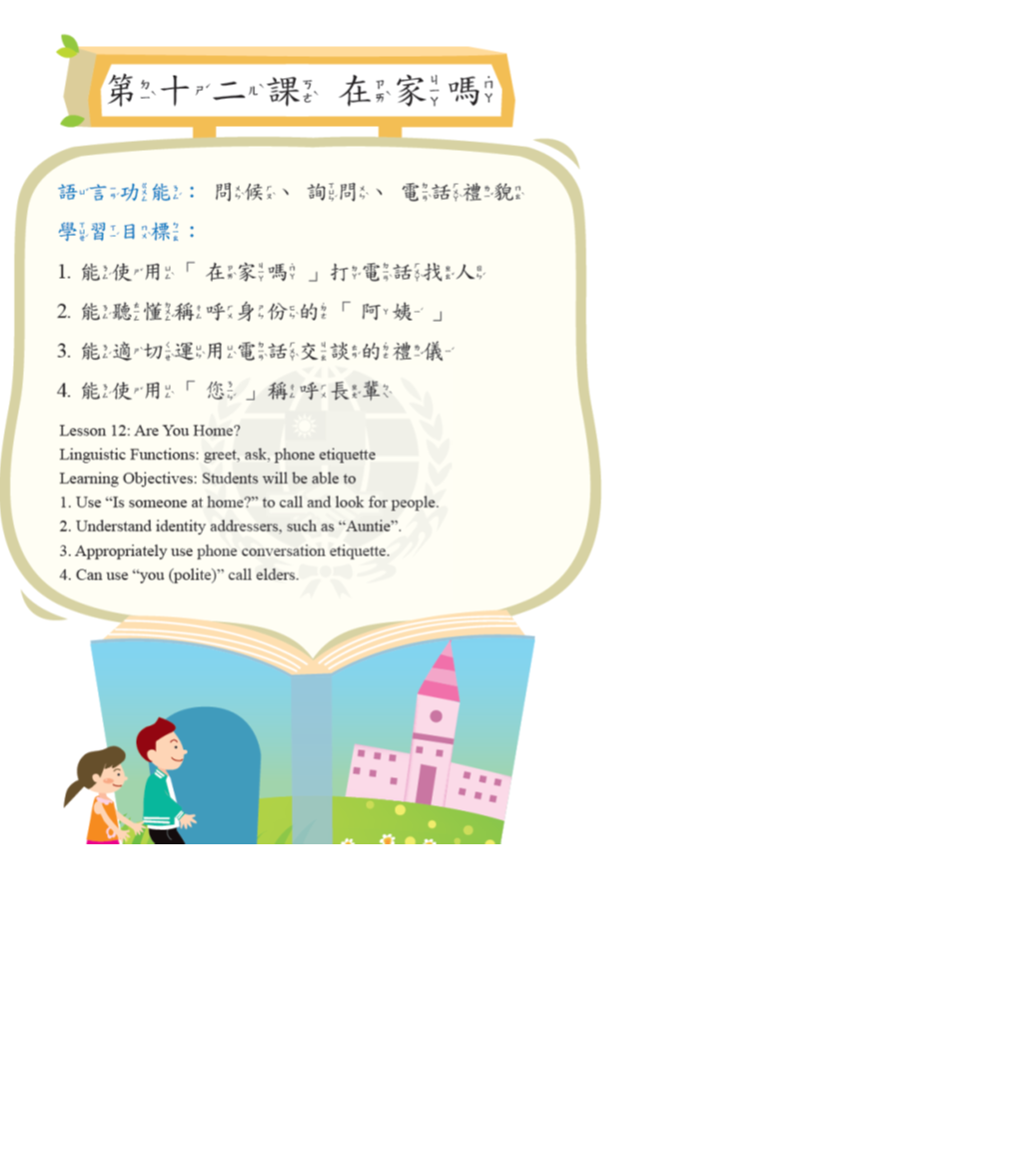
語言功能:問候、詢問、電話禮貌
學習目標:
1. 能使用「在家嗎」打電話找人
2. 能聽懂稱呼身份的「太太、阿姨」等詞
3. 能簡單且禮貌地回覆電話中對方的詢問
4. 能適切運用電話交談的禮儀
Linguistic Functions: Greet, Ask, Phone Etiquette
Learning Objectives: Students will be able to
1. Use “at home?” to call and look for people.
2. Understand identity addressers, such as “Mrs.”, “Auntie”, and related words.
3. Easily and politely respond to a question during a telephone conversation.
4. Appropriately use phone conversation etiquette.
- Teacher: Tai-Ping Chen
- Teacher: Joanna Chien
- Teacher: Jenny Chu
- Teacher: Yong Ping Li
- Teacher: wei ling
- Teacher: Mina Ting
- Teacher: Tracy Wang
- Teacher: Jenny Zhuang
語言功能:介紹、表達、比較、歡迎
學習目標:
1. 能介紹自己的名字、年齡、興趣等
2. 能以歡迎詞歡迎新朋友
3. 能以「很高興認識你(們)」回應新 朋友
4. 能和第一次見面的人互相應答
Linguistic Functions: introduce, express, compare, welcome
Learning Objectives: Students will be able to
1. Introduce their names, age and interests etc.
2. Welcome new friends with welcoming phrases.
3. Use “Nice to meet you (all)” to respond to new friends.
4. Answer and respond to people they just met.
- Teacher: Tai-Ping Chen
- Teacher: Joanna Chien
- Teacher: Jenny Chu
- Teacher: wei ling
- Teacher: Mina Ting
- Teacher: Tracy Wang
- Teacher: Jenny Zhuang
語言功能:詢問、回覆、表達
學習目標:
1. 能分辨「爺爺/奶奶」和「外公/外婆」 的不同
2. 能說出家人的職業名稱
3. 能表達未來志向
Linguistic Functions: ask, reply, express
Learning Objectives: Students will be able to
1. Differentiate between their paternal grandfather / grandmother and their
maternal grandparents.
2. Say the titles of their family members.
3. Express their future goals and aspirations
- Teacher: Tai-Ping Chen
- Teacher: Joanna Chien
- Teacher: Jenny Chu
- Teacher: Yong Ping Li
- Teacher: wei ling
- Teacher: Mina Ting
- Teacher: Tracy Wang
- Teacher: Jenny Zhuang
語言功能:詢問、回覆、邀請、表達
學習目標:
-
能表達想要的東西
-
能用「一起」、「...吧」邀請他人一起 做某事
-
能以「要...還要...」表達兩種需求
-
能以「可以...嗎?」徵求別人同意
Linguistic Functions: ask, reply, invite, express
Learning Objectives: Students will be able to
1. Express the things they want.
2. Use “together” and modal particle indicating suggestion or surmise “...ok?/...right?”to invite others to do certain things together.
3. Use “want...still wants” to express two kinds of needs. 4. Use “may...?” to ask for others’ permission
- Teacher: Tai-Ping Chen
- Teacher: Joanna Chien
- Teacher: Jenny Chu
- Teacher: Yong Ping Li
- Teacher: wei ling
- Teacher: Mina Ting
- Teacher: Tracy Wang
- Teacher: Jenny Zhuang
語言功能:詢問、回覆、要求、動作順序
學習目標:
1. 能表達自己喜歡吃的食物
2. 能詢問某事的可能性
3. 能接受他人的建議
Linguistic Functions: ask, reply, request, action sequence
Learning Objectives: Students will be able to
1. Express the foods they like.
2. Ask about the possibility of something.
3. Accept other people’s suggestions / advice.
- Teacher: Tai-Ping Chen
- Teacher: Joanna Chien
- Teacher: Jenny Chu
- Teacher: Yong Ping Li
- Teacher: wei ling
- Teacher: Mina Ting
- Teacher: Tracy Wang
- Teacher: Jenny Zhuang
學習目標:
1. 能學會不同的顏色詞
2. 能用「漂亮」表達對事物的感覺
3. 能用「舒服」表達對天氣的感覺
4. 能從數種選擇中選出自己最喜歡的事物
Linguistic Functions: order/command, express, suggest
Learning Objectives: Students will be able to
1. Learn different words about color.
2. Use “beautiful” to express their feelings for objects.
3. Use “comfortable” to describe how they feel towards the weather.
4. Choose their favorite things from a variety of choices.
- Teacher: Tai-Ping Chen
- Teacher: Joanna Chien
- Teacher: Jenny Chu
- Teacher: Yong Ping Li
- Teacher: wei ling
- Teacher: Mina Ting
- Teacher: Tracy Wang
- Teacher: Jenny Zhuang
語言功能:確認、詢問、敘述
學習目標:
1. 能使用「快到了」表達時間即將來臨
2. 能了解中國新年的習俗
3. 能以「太好了」表達開心的感覺
4. 能知道各地不同的習俗
Linguistic Functions: con rm, ask, describe
Learning Objectives: Students will be able to
1. Use “almost here” to indicate the arrival of time.
2. Understand customs and traditions of the Chinese New Year.
3. Use “that’s great” to express feelings of joy.
4. Know the customs and traditions of different places.
- Teacher: Tai-Ping Chen
- Teacher: Joanna Chien
- Teacher: Jenny Chu
- Teacher: Yong Ping Li
- Teacher: wei ling
- Teacher: Mina Ting
- Teacher: Tracy Wang
- Teacher: Jenny Zhuang
語言功能:告知、表達、敘述、提醒
學習目標:
1. 能學會與生活健康有關的詞
2. 能以「累、想睡覺」來表達自身狀況
3. 能使用「先...再...」來表達動作順序
4. 能以「還有」來提醒別人其他的事物
Linguistic Functions: inform, express, tell, remind Learning Objectives: Students will be able to
1. Learn words about health and living.
2. Use “tired, sleepy” to express the state of one’s own body. 3. Use “ rst...then” to express a sequence of actions.
4. Use “also” to remind others of things
- Teacher: Tai-Ping Chen
- Teacher: Joanna Chien
- Teacher: Jenny Chu
- Teacher: Yong Ping Li
- Teacher: wei ling
- Teacher: Mina Ting
- Teacher: Tracy Wang
- Teacher: Jenny Zhuang
語言功能:詢問、回答、表達、期望
學習目標:
1. 能以「隻」表示某些動物的量詞
2. 能使用「過」表達過去的經驗
3. 能以寵物作為交談話題
4. 能表達個人未來的期盼
Linguistic Functions: ask, respond, express, expect
Learning Objectives: Students will be able to
1. Use “zhī (measure word for animals)” to indicate the amount of animals.
2. Use “guò (particle used after a verb to indicate past experience)” to
express past experiences.
3. Use pets as a conversation topic.
4. Express their personal hopes for the future.
- Teacher: Tai-Ping Chen
- Teacher: Joanna Chien
- Teacher: Jenny Chu
- Teacher: Yong Ping Li
- Teacher: wei ling
- Teacher: Mina Ting
- Teacher: Tracy Wang
- Teacher: Jenny Zhuang
語言功能:詢問、回覆、說明
學習目標:
1. 能說出東、西、南、北,四個方位
2. 能藉由指南針說出教室及周邊建築的
方位
3. 能使用「因為…,所以…」來說明事
情的因果
Linguistic Functions: ask, reply, explain
Learning Objectives: Students will be able to
1. Say the coordinates of “East, West, South and North”.
2. Use a compass and talk about the coordinates of things around the
classroom and surrounding buildings.
3. Use “because..., therefore...” to explain the cause and effect of things.
- Teacher: Tai-Ping Chen
- Teacher: Joanna Chien
- Teacher: Jenny Chu
- Teacher: Yong Ping Li
- Teacher: wei ling
- Teacher: Mina Ting
- Teacher: Tracy Wang
- Teacher: Jenny Zhuang
語言功能:詢問、回覆、說明、介紹
學習目標:
-
能使用「家在那裡」、「住在哪裡」 詢問居住地
-
能使用「本來」、「以後」來說明前 後不同的情況
-
能使用「每...都...一次」來表達例行 性習慣
-
能學會「爺爺、奶奶」與「外公、外 婆」的不同
Linguistic Functions: ask, reply, explain, introduce
Learning Objectives: Students will be able to
1. Use “where is your house”, “where do you live” to ask where people live.
2. Use “originally”, “after” to explain situations from beginning to end.
3. Use “every...all...once” to express routine habits.
4. Tell the difference between paternal grandparents and maternal grandparents.
- Teacher: Tai-Ping Chen
- Teacher: Joanna Chien
- Teacher: Jenny Chu
- Teacher: Yong Ping Li
- Teacher: wei ling
- Teacher: Mina Ting
- Teacher: Tracy Wang
- Teacher: Jenny Zhuang
語言功能:喜好、對比、描述
學習目標:
-
能說出動物的名稱,如大象、老虎、熊 貓、企鵝等
-
能使用「希望」來表達心中的盼望
-
能使用「胖胖的」、「長長的」來描述 動物的外
Learning Objectives: Students will be able to
1. Name various animals such as the elephant, tiger, panda and
penguin etc.
2. Use “wish” to express their hopes.
3. Use “fat” and “long” to describe the appearance of animals.
- Teacher: Tai-Ping Chen
- Teacher: Joanna Chien
- Teacher: Jenny Chu
- Teacher: Yong Ping Li
- Teacher: wei ling
- Teacher: Mina Ting
- Teacher: Tracy Wang
- Teacher: Jenny Zhuang
語言功能:詢問、回覆、描述、建議、 允諾
學習目標:
1. 能使用「看起來」來描述人或物
2. 能使用「高、瘦」描述外型
3. 能使用「有意思」來表達對事物感興趣
4. 能使用「一定會」來表達承諾
Linguistic Functions: ask, reply, describe, suggest, promise
Learning Objectives: Students will be able to
1. Use “looks as if” to describe people or things.
2. Use “tall, skinny” to describe appearances.
3. Use “meaningful” to express interest in things.
4. Use “certainly/de nitely will” to indicate promises.
- Teacher: Tai-Ping Chen
- Teacher: Joanna Chien
- Teacher: Jenny Chu
- Teacher: Yong Ping Li
- Teacher: wei ling
- Teacher: Mina Ting
- Teacher: Tracy Wang
- Teacher: Jenny Zhuang
語言功能:歡迎、詢問、回答、敘述
學習目標:
1. 能敘述假期時做的活動
2. 能表達在某個時間做什麼活動
3. 能向老師提出問題或要求
4. 能聽懂並接受他人的命令
Linguistic Functions: welcome, inquire, answer,
recount
Learning Objectives:
1. Can recount what he or
she did on vacation / holiday.
2. Can describe what he or
she did at a certain time.
3. Can present questions or
requests to a teacher.
4. Can understand and
accept verbal commands.
- Teacher: Tai-Ping Chen
- Teacher: Joanna Chien
- Teacher: Jenny Chu
- Teacher: Yong Ping Li
- Teacher: wei ling
- Teacher: Mina Ting
- Teacher: Tracy Wang
- Teacher: Jenny Zhuang
語言功能:詢問、回覆、敘述、提議
學習目標:
1. 能以「怎麼樣」來詢問他人狀況
2. 可以表達「開心、累、餓」的感覺
3. 能重述他人說過的話
4. 能用「…了…,再…」來表達動作的先後順序
Linguistic
Functions: inquire, respond, recount, propose
Learning Objectives:
1. Can use “how are / is
(someone / something)” to ask
about someone or
something’s condition.
2. Can express feelings of
happiness, tiredness, and hunger.
3. Can restate what someone
else said.
4. Can use “了” and “再” to express the
sequential order
of different actions.
- Teacher: Tai-Ping Chen
- Teacher: Joanna Chien
- Teacher: Jenny Chu
- Teacher: Yong Ping Li
- Teacher: wei ling
- Teacher: Mina Ting
- Teacher: Tracy Wang
- Teacher: Jenny Zhuang
語言功能:詢問、要求、選擇、比較
1. 能說出文具的名稱
2. 能使用「貴、便宜」表達感受
3. 能說出東西價錢及使用「一共多少錢」詢
問東西的總價
4. 能用「又…又…」描述事物
Linguistic Functions: inquire, request, choose, compare
Learning Objectives:
1. Can name school supplies.
2. Can say whether he or she thinks something is expensive or
inexpensive.
3. Can say the price of something and use “how much is it
altogether?” to ask for the total price.
4. Can use the “又” particle to describe multiple characteristics
of something.
- Teacher: Tai-Ping Chen
- Teacher: Joanna Chien
- Teacher: Jenny Chu
- Teacher: Yong Ping Li
- Teacher: wei ling
- Teacher: Mina Ting
- Teacher: Tracy Wang
- Teacher: Jenny Zhuang
語言功能:詢問、選擇、請求、提醒
1. 能邀請朋友做某事
2. 能使用「如果…,就太好了」表達期望
3. 能使用「或是」表達兩者的選擇
4. 能使用「能不能」向他人提出要求
Linguistic Functions: inquire, choose, request, remind
1. Can invite a friend to do something.
2. Can use “If (clause), that would be wonderful” to express
anticipation.
3. Can use “or” to present two choices.
4. Can make a request by asking if something is or isn’t
possible.
- Teacher: Tai-Ping Chen
- Teacher: Joanna Chien
- Teacher: Jenny Chu
- Teacher: Yong Ping Li
- Teacher: wei ling
- Teacher: Mina Ting
- Teacher: Tracy Wang
- Teacher: Jenny Zhuang
語言功能:詢問、表達、建議
1. 能用「涼快、暖和、舒服」說明天氣
2. 能說出氣溫是幾度
3. 能用「差不 多」表示大概的情況
4. 能用「不得了」表示程度很高
Linguistic Functions: inquire, express, recommend
Learning Objectives:
1. Can use “cool”, “warm”, and “comfortable” to describe the
weather.
2. Can tell the temperature.
3. Can use “pretty much” to give a general idea of the situation.
4. Can use “extremely” to express the high degree of
something.
- Teacher: Tai-Ping Chen
- Teacher: Joanna Chien
- Teacher: Jenny Chu
- Teacher: Yong Ping Li
- Teacher: wei ling
- Teacher: Tracy Wang
- Teacher: Jenny Zhuang
1. 能用「好」描述事物的程度
2. 能用「就是」表示某個時間即將到來
3. 能正確使用量詞「棵、輛、隻、張、個」
4. 能說出節日希望得到的禮物
Linguistic Functions: compare, express, request, inquire
Learning Objectives:
1. Can use “好” to express the significant degree of something
(like “quite”).
2. Can use “just” to indicate the time for something has almost
arrived.
3. Can correctly use the measure words “棵”, “輛”, “隻”,
“張”, and “個.”
4. Can say the gifts he or she would like to receive on a holiday.
- Teacher: Tai-Ping Chen
- Teacher: Joanna Chien
- Teacher: Jenny Chu
- Teacher: Yong Ping Li
- Teacher: wei ling
- Teacher: Mina Ting
- Teacher: Tracy Wang
- Teacher: Jenny Zhuang
語言功能:詢問、描述、推測、建議
1. 能用「怎麼了」詢問別人發生什麼事
2. 能用「痛」表達身體不舒服的感覺
3. 能用「為什麼」來問答
4. 能轉述別人的話
Linguistic Functions: inquire, describe, speculate, recommend
Learning Objectives:
1. Can use “what happened to (someone / something)?” to ask
someone what happened to them.
2. Can use “hurts” to describe a feeling of physical discomfort.
3. Can use “why” to ask how something happened.
4. Can quote something someone else said.
- Teacher: Tai-Ping Chen
- Teacher: Joanna Chien
- Teacher: Jenny Chu
- Teacher: Yong Ping Li
- Teacher: wei ling
- Teacher: Mina Ting
- Teacher: Tracy Wang
- Teacher: Jenny Zhuang
語言功能:邀請、敘述、意願、協商
1. 能用「不敢」表達害怕的事物
2. 能用「才」表達事情發生的時間在不久
之前
3. 能學會用「剪刀、石頭、布」來猜拳
4. 能學會表達意願並跟人協商
Linguistic Functions: invite, recount, desire, consult
Learning Objectives:
1. Can use “don’t dare to” to express fear of something.
2. Can use “才” to express that something happened just recently.
3. Can play Rock-Paper-Scissors in Chinese.
4. Can express desire to do something and can consult with
someone.
- Teacher: Tai-Ping Chen
- Teacher: Joanna Chien
- Teacher: Jenny Chu
- Teacher: Yong Ping Li
- Teacher: wei ling
- Teacher: Mina Ting
- Teacher: Tracy Wang
- Teacher: Jenny Zhuang
語言功能:確認、詢問、回覆、描述
1. 能使用「離…」來詢問距離遠近
2. 能敘述左右鄰居的概況
3. 能使用「左邊、右邊」來描述住家附近的
環境
4. 能說出自己家的住址
Linguistic Functions: confirm, inquire, reply, describe
Learning Objectives:
1. Can use “from” to inquire about distance.
2. Can describe the neighbors to his or her right and left.
3. Can use “right” and “left” to describe the immediate
vicinity of his or her home.
4. Can say his or her address.
- Teacher: Tai-Ping Chen
- Teacher: Joanna Chien
- Teacher: Jenny Chu
- Teacher: Yong Ping Li
- Teacher: wei ling
- Teacher: Tracy Wang
- Teacher: Jenny Zhuang
語言功能:介紹、表達、建議
1. 能介紹中華文化與產物
2. 能使用「除了…,還…」表達兩種動作/事物
3. 能使用「怎麼辦」來提出請求
4. 能使用「什麼都」表示所有的事物
Linguistic Functions: introduce, express, recommend
Learning Objectives:
1. Can introduce Chinese culture and products.
2. Can use “besides (A), also (B)”to express two actions.
3. Can ask “What should (subject) do?” to request
guidance.
4. Can use “什麼都” to express “all” or “none.”
- Teacher: Tai-Ping Chen
- Teacher: Joanna Chien
- Teacher: Jenny Chu
- Teacher: Yong Ping Li
- Teacher: wei ling
- Teacher: Mina Ting
- Teacher: Tracy Wang
- Teacher: Jenny Zhuang
語言功能:詢問、喜好、描述、比較
1. 能說出喜歡的遊樂設施
2. 能描述遊樂設施的特色
3. 能使用「有趣、可怕、緊張」描述自己的感覺
4. 能使用「很、最、更」比較程度的差異
學華語向前走 Let's Learn Chinese
Linguistic Functions: inquire, like, describe, compare
Learning Objectives:
1. Can say which amusement park facilities he or she likes.
2. Can describe what’s unique about an amusement park’s
facilities.
3. Can describe something as interesting, scary, or nervewracking.
4. Can use “quite” (很), “most” (最), and “more” (更) to
express degrees.
- Teacher: Tai-Ping Chen
- Teacher: Joanna Chien
- Teacher: Jenny Chu
- Teacher: Yong Ping Li
- Teacher: wei ling
- Teacher: Mina Ting
- Teacher: Tracy Wang
- Teacher: Jenny Zhuang
語言功能:敘述、詢問、請求
1. 能使用「特別」來形容事物
2. 能使用「你可以…嗎?」來請求別人教導
3. 能說出生日卡片上圖案的名稱
4 能使用「生日快樂」、「天天開心」來表達
生日祝福
Linguistic Functions: recount, inquire, request
Learning Objectives:
1. Can use “special” to describe something.
2. Can ask “can you (X)?” to request guidance from someone.
3. Can describe a birthday card design.
4. Can use “Happy Birthday” and “happiness every day” to
express birthday wishes.
- Teacher: Tai-Ping Chen
- Teacher: Joanna Chien
- Teacher: Jenny Chu
- Teacher: Yong Ping Li
- Teacher: wei ling
- Teacher: Tracy Wang
- Teacher: Jenny Zhuang
語言功能:宣布、詢問、回覆、請求
學習目標:
1. 能表達動作進行的時間
2. 能請求別人幫忙及答應別人的請求
3. 能使用「把」字句
4. 能使用「是不是…就…」表達條件
Linguistic Functions: announce, inquire, reply, request
Learning Objectives:
1. Can express the time when an action is undertaken.
2. Can request someone’s help and respond to someone’s
request.
3. Can use the direct object particle “把”
4. Can use“once (action), (action), right?”in a conditional
sentence.
Let's Learn Chinese
語言功能:詢問、敘述、建議、猜測
學習目標:
1. 能邀請別人參加活動
2. 能提供建議給他人
3. 能使用「讓」和「不讓」表達是否允許
4. 能使用「聽說」轉述他人話語
Linguistic Functions: inquire, describe, recommend, guess
Learning Objectives:
1. Can invite someone to an activity.
2. Can provide someone recommendations.
3. Can use “let” and “don’t let” to express whether permission is given.
4. Can use “heard that” to pass on something someone else said.
語言功能:邀請、拒絕、詢問、建議
學習目標:
1. 能邀請人做某件事
2. 能使用「點 / 分 / 半」等時間用詞
3. 能用「V 到+(時間)」表達動作結束的時間
4. 能使用「從…到…」表達某個動作進行的時間長度
Linguistic Functions: invite, reject, inquire, recommend
Learning Objectives:
1. Can invite someone to do something.
2. Can use time words such as “o’clock”, “minute”, and “half”.
3. Can use “(verb) until (time)” to express the time an action ends.
4. Can use “from (X) to (X)” to express the amount of time an action takes.
語言功能:抱怨、誇獎、要求、建議
學習目標:
1. 能使用「酸、甜、苦、辣」等形容詞疊詞
2. 能使用「越來越」表示狀態的改變
3. 能表達食物的味道
4. 能要求他人做或不做某事
Linguistic Functions: complain, praise, demand, recommend
Learning Objectives:
1. Can use the reduplicated forms of adjectives such as
“sour”, “sweet”, “bitter”, and “spicy”.
2. Can use “more and more” to express a changing
situation.
3. Can communicate the taste of food.
4. Can demand someone do or not do something.
語言功能:詢問、回覆、表達、建議
學習目標:
1. 能解釋做某事的理由
2. 能建議他人做某事
3. 能堅持某個意見
4. 能用「而且」表達兩種情況
Linguistic Functions: inquire, reply, express, recommend
Learning Objectives:
1. Can explain the reasons for something.
2. Can recommend someone do something.
3. Can uphold an opinion.
4. Can use “and also” to express two situations.
語言功能: 描述、詢問、回覆、
話題接續
學習目標:
1. 能描述春節唐人節的活動
2. 能描述新年的活動
3. 能使用「叫」要求某人做某事
4. 能使用「另外」補充說明
Linguistic Functions:
describe, inquire, respond, continue the conversation topic
Learning Objectives:
1. Can describe Chinatown Spring Festival activities.
2. Can describe Chinese New Year activities.
3. Can use “叫” to tell someone to do something.
4. Can use “besides” to supplement an explanation.
語言功能:詢問、回覆、描述、建議
學習目標:
1. 能表達受傷的部位及原因
2. 能表達疼痛的感覺
3. 能使用「雖然…,但是…」表達轉折
4. 能使用「只要…就…」表達條件的限制
Linguistic Functions: inquire, respond, describe, recommend
Learning Objectives:
1. Can express the position of and reason for an injury.
2. Can describe the pain.
3. Can use “although (X), (Y)” as a turning point in a sentence.
4. Can use “if only... then...” to express conditional restrictions.
語言功能:敘述、詢問、回覆、意願
學習目標:
1. 能轉達他人說的話
2. 能說明「功夫」的意涵
3. 能告訴別人學功夫的好處
4. 能使用「想試試」表達嘗試的意願
Linguistic Functions: recount, inquire, respond, wish
Learning Objectives:
1. Can convey something someone else said.
2. Can explain what kung fu is.
3. Can tell someone advantages of studying kung fu.
4. Can use “want to try it” to express a desire to try something.
語言功能:敘述、詢問、回覆、說明
學習目標:
1. 能說出東北、東南等方位詞
2. 能說出國家及城市名稱
3. 能解釋城市在國家的方位
4. 能使用「你知道…嗎」來詢問他人
Linguistic Functions: recount, inquire, respond, explain
Learning Objectives:
1. Can say orientation words like northeast and southeast.
2. Can say countries’ and cities’ names.
3. Can explain where cities and countries are.
4. Can use “Do you know…?” to ask someone something.
語言功能:詢問、比較、描述、解釋
學習目標:
1. 能使用「有什麼不一樣」來進行比較
2. 能描述不同文字的外型特色
3. 能說出西方文字的拼寫共同處
4. 能說出漢字存在多久
Linguistic Functions: inquire, compare, describe, explain
Learning Objectives:
1. Can use “what’s the difference” to make comparisons.
2. Can describe the unique appearances of different writing systems.
3. Can express the similarities in spelling and writing between different Western writing systems.
4. Can say how long Chinese characters have existed.
語言功能:詢問、建議、同意、要求
學習目標:
1. 能表達自己想去的地方
2. 能描述想去地方的特色
3. 能使用動詞重疊式
4. 能肯定他人的意見
Linguistic Functions: inquire, recommend, agree, demand
Learning Objectives:
1. Can express a place he/she wants to go.
2. Can describe the special characteristics of the place he / she
wants to go.
3. Can use reduplicated verbs.
4. Can approve of someone else’s opinion.
語言功能:詢問、回覆、建議、同意
學習目標:
1. 能依照他人情況給予建議
2. 能用「有沒有別的辦法」希望他人
提議
3. 能表達對新產品、新科技的感覺
4. 能使用「對了」表達新的想法
Linguistic Functions: inquire, respond, recommend, agree
Learning Objectives:
1. Can give recommendations in light of other people’s situations.
2. Can use “is there another way” to express hope for a recommendation
from someone else.
3. Can express feelings about new products and technology.
4. Can use “by the way / that’s right” to express a new thought.
語言功能:詢問、話題接續、表達
學習目標:
1. 能以「如果」表達事情的可能性
2. 能表達對某事有興趣
3. 能表達從某段時間進行或結束某事
4. 能比較兩種事物的不同程度
Linguistic Functions: inquire, continue a conversation, express
Learning Objectives:
1. Can use “if” to express a possibility.
2. Can express interest in something.
3. Can express the time when someone started or finished something.
4. Can compare the degrees of two things.
語言功能:告知、詢問、說明、描述
學習目標:
1. 能對中秋節有簡單的了解
2. 能了解中秋節代表的意義
3. 能了解陰曆和陽曆的不同
4. 能用「一邊…,一邊…」表達同時進行兩件動作
Linguistic Functions: notify, inquire, explain, describe
Learning Objectives:
1. Can have a simple understanding of Mid-Autumn Festival.
2. Can understand the meaning of Mid-Autumn Festival.
3. Can understand the difference between the solar and lunar calendar.
4. Can use “一邊 / 一邊” to express two simultaneous activities.
語言功能:詢問、說明、拒絕、要求
學習目標:
1. 能表達想買的東西並說明原因
2. 能與他人以交換條件方式達到目的
3. 能使用「差一點」表達情況發生的可能性
4. 能使用「把」字句加「結果補語」的用法
Lesson 3: I Want to Buy a New Toy
Linguistic Functions: inquire, explain, reject, demand
Learning Objectives:
1. Can express what he or she wants to buy and explain why.
2. Can achieve a goal by making a conditional agreement with someone.
3. Can use “almost” to express the probability of something occurring.
4. Can use the direct object particle and a completed-action suffix in the
same sentence.
語言功能:詢問、描述、話題接續、說明
學習目標:
1. 能了解月餅與南瓜派作法的不同
2. 能了解吃南瓜派的原因
3. 能用「V 起來」表達感覺
4. 能使用「再加上」表達兩種以上的原因
Linguistic Functions: inquire, describe, continue the conversation topic, explain
Learning Objectives:
1. Can understand the different ways of making mooncakes and pumpkin pie.
2. Can understand the reason for eating pumpkin pie.
3. Can use the “V起來” form connecting a verb with the feeling or impression it gives to express how something feels.
4. Can use “on top of that” to express two or more reasons.
語言功能:說明、表達、描述、話題接續
學習目標:
1. 能簡單了解各國新年活動的不同
2. 能了解各國國家新年的時間有所不同
3. 能了解各國新年活動所代表的意義
4. 能以“特別是…"表示與其他事物的不同
Linguistic Functions: Explain, express, describe, continue a conversation topic
Learning Objectives:
1. Can simply understand the differences between countries’ new year’s
activities.
2. Can understand the differences between the times countries celebrate the
new year.
3. Can understand the meaning of different countries’ new year’s activities.
4. Can use “especially / in particular” to express how something is different.
語言功能:誇獎、表達、敘述、建議
學習目標:
1. 能表達對某事有興趣
2. 能拒絕他人的要求並建議他人
3. 能使用中文書寫日記
4. 能說明蛋糕的做法
Linguistic Functions: Compliment, express, narrate, recommend
Learning Objectives:
1. Can express interest in something.
2. Can reject someone’s demand and can give a suggestion to someone.
3. Can write the date in Chinese.
4. Can explain how to make a cake
語言功能:詢問、表達、描述、提醒
學習目標:
1. 能說出生病時的原因與症狀
2. 能以「一 N V Nu 次」表達一段時間進行幾
次動作
3. 能用「是…的」句型強調焦點
4. 能了解生病時應遵照醫生的指示
Linguistic Functions: Inquire, express, describe, remind
Learning Objectives:
1. Can say the reasons for and symptoms of an illness.
2. Can express the frequency of an action using the “(verb) (number of times) a/per (time period)” sentence structure.
3. Can use the “is (the one that)” (是...的) sentence structure to stress the focus.
4. Can understand that when one is sick, one should obey the instructions of the doctor.
語言功能:提醒、回應、提議、話題接續
學習目標:
1. 能表達運動比賽的情況
2. 能使用「第」表達序數
3. 能使用「為了」表示要達到某個目的應做之事
4. 能用「連…也…」表示要強調的部分
Linguistic Functions: Remind, respond, propose, continue a conversation topic
Learning Objectives:
1. Can express the situation in a sporting competition.
2. Can use 第 to express ordinal numbers.
3. Can use “in order to” to express something that should be done to meet a goal.
4. Can use “even (noun) (verb)” to emphasize something.
語言功能:描述、說明、詢問
學習目標:
1. 能學會世界有六大洲
2. 能學會六大洲的面積大小及人口多寡
3. 能學會從不同角度來看地圖,知道各洲的位置不同
4. 能說出台灣所在位置
Linguistic Functions: describe, explain, inquire
Learning Objectives:
1. Can learn the world’s six continents.
2. Can learn the surface areas and populations of the six continents.
3. Can look at maps from different angles to see the differences in the position of each continent.
4. Can say where Taiwan is located.
語言功能:表達、提議、詢問、描述
學習目標:
1. 能提出建議
2. 能描述從A 處到B 處怎麼走
3. 能以「Number + 幾+ M + N」表示事物的概數
4. 能以「Nu + 個+ 多小時 / 星期 / 月」表達時間的概數
Linguistic Functions: express, propose, inquire, describe
Learning Objectives:
1. Can make a recommendation.
2. Can describe how to go from place A to place B.
3. Can use “(number)-some (measure or time word)” to give a rough
estimate of the quantity of something.
4. Can use “(number)-plus hours / weeks / months” to give a rough
estimate of the length of time of something.
語言功能:詢問、說明、描述
學習目標:
1. 能了解生活中哪些東西是由「紙」做成
的
2. 能了解「紙」過去和現在作法的不同
3. 能了解「紙」的重要性以及帶來的問題
4. 能了解環境保護的重要性及保護的方法
Linguistic Functions: inquire, explain, describe
Learning Objectives:
1. Can understand what everyday things are made from paper.
2. Can understand the differences between the past and present methods of
papermaking.
3. Can understand the importance of paper as well as the problems it brings.
4. Can understand the importance of environmental protection and ways of
protecting the environment.
語言功能:表達、敘述、建議、詢問
學習目標:
1. 能向他人說明如何前往某處
2. 能了解愛護動物的重要性
3. 能學習敘述文的表達方式
4. 能給他人建議
Linguistic Functions: esxpress, describe, recommend, inquire
Learning Objectives:
1. Can explain to someone how to go somewhere.
2. Can understand the importance of loving animals.
3. Can learn the mode of expression of a narrative.
4. Can give someone a suggestion
語言功能:敘述、話題接續、建議、承諾
學習目標:
1. 能描述所學的才藝課
2. 能使用「把」字句的不同功能
3. 能表示自己所學才藝的能力
4. 能與他人分享所學才藝的成果
Linguistic Functions: recount, continue a conversation topic,
recommend, promise
Learning Objectives:
1. Can describe a skill he or she is learning in class.
2. Can use the direct object particle “把” in different ways.
3. Can express the skills he or she has learned.
4. Can share the results of studying skills語言功能:詢問、回覆、更正、說明
學習目標:
1. 能學習數首與月亮有關的詩
2. 能對詩人李白有粗淺地了解
3. 能使用「想起來」與「想不起來」表示
記得或忘記某事
4. 能表達兩件事情的相關性
Linguistic Functions: inquire, respond, correct, explain
Learning Objectives:
1. Can learn multiple poems related to the moonlight.
2. Can roughly understand the poet Li Bai.
3. Can use “thought of” and “can’t think of” to express whether
one has remembered or forgotten something.
4. Can express the correlation between two things
語言功能:詢問、敘述、對比、話題接續
學習目標:
1. 能知道十二生肖是哪十二種動物
2. 能依照出生年份了解自己的生肖
3. 能比較歲數的不同並指出相屬的生肖
4. 能使用「從來沒…」表示一直以來還沒做過某事
Linguistic Functions: inquire, recount, compare, continue a conversation topic
Learning Objectives:
1. Can know which 12 animals are the 12 zodiac signs.
2. Can know his or her own zodiac sign based on which year he or she was
born.
3. Can compare ages to point out which zodiac signs people belong to.
4. Can use “have never” to express something he or she has never done
before.
語言功能:告知、確認、說明、對比
學習目標:
1. 能了解南北半球聖誕節的不同處
2. 能了解南北半球氣候及季節上的不同
3. 能使用「相反」表示兩件事物的不同
4. 能使用「難怪」表事後理解原因
Linguistic Functions: inform, confirm, explain, compare
Learning Objectives:
1. Can understand the differences between Christmas in the northern and
southern hemisphere.
2. Can understand the differences in climate and seasons between the
northern and southern hemisphere.
3. Can use “opposite” to express the differences between two things.
4. Can use “no wonder” to express understanding of the reasons for
something that’s already happened.
語言功能:說明、話題接續、解釋、詢問
學習目標:
1. 能了解中國新年應做的事及禁忌
2. 能學習與新年有關的成語
3. 能了解中國新年習俗所代表的意思
4. 能使用「被」字句
Linguistic Functions: explain, continue a conversation topic, explain, inquire
Learning Objectives:
1. Can explain what one should and shouldn’t do on Chinese New Year.
2. Can learn idioms related to the new year.
3. Can understand what Chinese New Year customs represent.
4. Can use the passive voice particle “被”.
語言功能:告知、敘述、話題延續、提醒
學習目標:
1. 能表達心情不佳的原因
2. 能誇獎他人的才藝能力
3. 能敘述在中文學校所學到的知識
Linguistic Functions: inform, recount, continue a conversation topic, remind
Learning Objectives:
1. Can express reasons for being in a bad mood.
2. Can praise someone else’s abilities.
3. Can describe everything he or she has learned in Chinese school語言功能:敘述、勸告、詢問、話題接續
學習目標:
1. 能表達自己喜歡和討厭的菜
2. 能了解哪些食物對身體有幫助
3. 能用「一…就…」表示做完某事立刻做
另一件事
4. 能用「…等等」舉例
Linguistic Functions: recount, advise, inquire, continue a conversation
topic
Learning Objectives:
1. Can say the foods he or she likes and dislikes.
2. Can understand what foods are healthy.
3. Can use “as soon as + (verb)” to express that once one action is
completed another will take place.
4. Can use “etc. / and so on” while giving examples語言功能:表達、敘述、承諾、詢問
學習目標:
1. 能使用中文寫書信
2. 能了解中文書信的格式
3. 能敘述過去及未來要做的事
4. 能用「Vs 得…」表示一種感覺所帶來的影響
Linguistic Functions: express, recount, promise, inquire
Learning Objectives:
1. Can use Chinese to write a letter.
2. Can understand the format of a Chinese letter.
3. Can recount past events and things that must or will be done in the future.
4. Can use the “verb + 得 (adverbial particle)” form to express the influence of a feeling.
語言功能:描述、方位、介紹
學習目標:
1. 能了解台灣的地理位置
2. 能了解台灣的地理與地形
3. 能了解台灣幾個主要的城市
4. 能了解台灣主要城市的特色
Linguistic Functions: describe, locate, introduce
Learning Objectives:
1. Can understand Taiwan’s geographic location.
2. Can understand Taiwan’s geography and topography.
3. Can understand some of Taiwan’s important cities.
4. Can understand the special qualities of Taiwan’s important cities
語言功能:敘述、要求、詢問、建議
學習目標:
1. 能描述在農場裡能做的事
2. 能表達及要求想做的事
3. 能介紹農場的特色
4. 能用「順便」表示進行兩種事情
Linguistic Functions: recount, demand, inquire, recommend
Learning Objectives:
1. Can describe what one can do at a farm.
2. Can express and demand what he or she wants to do.
3. Can introduce the special qualities of Green Mountain Farm.
4. Can use “順便” (along the way/while we’re at it) to talk about doing two
things.
語言功能:敘述、舉例、比較、詢問
學習目標:
1. 能了解「筆」的重要性
2. 能了解「筆」過去和現在的差異
3. 能了解「筆」的功能種類
4. 能使用「A 沒有B 那麼…」表示兩者的不同
Linguistic Functions: recount, give examples, compare, inquire
Learning Objectives:
1. Can understand the importance of pens.
2. Can understand the difference between past and present pens.
3. Can understand the different functions of pens.
4. Can use “A isn’t as (adjective) as B” to express the difference between two Things
語言功能:詢問、話題接續、表達、建議
學習目標:
1. 能描述旅行的經驗
2. 能推薦他人去某處
3. 能了解書法和國畫的重要性
4. 能了解飲食均衡對身體的好處
Linguistic Functions: inquire, continue a conversation topic, express, recommend
Learning Objectives:
1. Can express the experiences he or she had on a trip.
2. Can recommend someone go somewhere.
3. Can understand the importance of calligraphy and traditional Chinese painting.
4. Can understand the advantages of nutritional balance for the body.
語言功能:話題接續、比較、描述、請求
學習目標:
1. 能使用「就是」表達強調
2. 能表達自己喜歡的課並說明原因
3. 能使用「像…」來舉例
4. 能使用「一點也不」表達對狀態動詞的否定
Linguistic Functions: topic connecting, comparing, describing, requesting
Learning Objectives:
1. Can use “indeed, truly” to express emphasis.
2. Can express which courses you like and explain the reasons.
3. Can use “be like...” to make an example.
4. Can use “does not __ at all” to express negation of a verb.
語言功能:詢問、解釋、比較、誇獎
學習目標:
1. 能表達事情的前因後果
2. 能表達不同國家在文化上的不同
3. 能使用「A 不像B」強調兩者不同
4. 能誇獎別人的才能
Linguistic Functions: asking, explaining, comparing, praising
Learning Objectives:
1. Can express causes and effects of events.
2. Can express cultural differences between different countries.
3. Can use “A is not like B” to emphasize the differences between the two.
4. Can praise the talents of others.
語言功能:描述、解釋、確認、勸告
學習目標:
1. 能使用「倍」表達數量的多寡
2. 能使用「要不然」來解釋、建議或警告
他人
3. 能了解「折」和「%off」的不同及轉換
使用
4. 能算出物品打折後的價錢及總價
Linguistic Functions: describing, explaining, confirming, giving advice
Learning Objectives:
1. Can use “times/-fold” to express comparative quantities.
2. Can use “otherwise” to explain, suggest, or warn others.
3. Can understand the difference between “discount” and
“ %off ” and switch between them.
4. Can calculate the price and total price of items on sale.
語言功能:命令、介紹、提醒、建議
學習目標:
1. 能使用「把字句」加補語
2. 能使用「先…然後…」表達事情的先後順序
3. 能了解餃子的製作過程
4. 能比較義大利餃子與中國餃子在外型及內
餡等的不同
Linguistic Functions: commanding, describing, reminding, suggesting
Learning Objectives:
1. Can use complements with a sentence.
2. Can use “First… then…” to express the order of events.
3. Can understand the process for making dumplings.
4. Can compare the differences between Italian ravioli and Chinese
dumplings in appearance and stuffing.
語言功能:詢問、話題接續、說明、期望
學習目標:
1. 能使用「曾經」表達過去的經驗
2. 能了解嘉年華會的特色
3. 能使用「從…一直到…」表示動作的持續
4. 能使用「非V 不可」表示一定要做某事
Linguistic Functions: asking, topic connecting, explaining, expecting
Learning Objectives:
1. Can use “ever” to express previous experiences.
2. Can understand the special features of Carnival.
3. Can use “from…to the present time…” to express the continuation of actions.
4. Can use “must V” to express specific events and actions which must be
performed.
語言功能:建議、同意、期望、描述
學習目標:
1. 能提出建議做某事的原因
2. 能同意他人的建議並提出其他的原因
3. 能描述旅遊的景點
4. 能在與他人討論後做出決定
Linguistic Functions: suggesting, agreeing, wishing, describing
Learning Objectives:
1. Can make suggestions about the reasons for a specific event.
2. Can agree with the suggestions of others and mention other reasons.
3. Can describe points of interest for travel.
4. Can decide after discussions with others.
語言功能:提醒、解釋、對比、道歉
學習目標:
1. 能了解不浪費食物的重要性
2. 能了解不浪費食物的方法
3. 能使用「再也不」表達不想再做某事
4. 能使用「對不起」表達道歉
Linguistic Functions: reminding, explaining, comparing, apologizing
Learning Objectives:
1. Can understand the importance of not wasting food.
2. Can understand methods for not wasting food.
3. Can use “will never V again…” to express an action which will not be done again.
4. Can use “I’m sorry” to express an apology.
第七冊 第八課 流行音樂 Lesson 8: Pop Music
學習目標:
1. 能了解各式各樣的音樂
2. 能簡單了解古典音樂與現在音樂的不同
3. 能敘述音樂給人帶來的好處
4. 能使用「原來」表達對一件事情從不了解到了解
Linguistic Functions: reminding, asking, topic connection, explaining
Learning Objectives:
1. Can understand a wide variety of music.
2. Has basic understanding of the differences between classical music and modern music.
3. Can describe the advantages music brings to people.
4. Can use “originally” to express the shift from a lack of understanding to understanding of something
語言功能:詢問、解釋、描述、期望
學習目標:
1. 能了解新台幣及美金上面的人物
2. 能了解孫中山對中華民國的重要性
3. 能了解華盛頓對美國的重要性
4. 能使用「只有…才…」表達條件
Linguistic Functions: asking, explaining, describing, expecting
Learning Objectives:
1. Can understand who is on Taiwan and US banknotes.
2. Can understand the importance of Sun Yat-sen for the Republic of China.
3. Can understand the importance of George Washington for the United States.
4. Can use “only N can…” to express conditions.
語言功能:詢問、回答、舉例、期望
學習目標:
1. 能了解孫中山及華盛頓對國家的重要性
2. 能以兩位偉人為學習目標
3. 能表達自己未來的期望
4. 能接受他人的建議
Linguistic Functions: asking, answering, giving examples, expecting
Learning Objectives:
1. Can understand the importance of Sun Yat-sen and George Washington for
their respective nations.
2. Can use these two great men as models for study.
3. Can express one’s expectations of the future.
4. Can accept others’ suggestions
語言功能:比較、解釋、舉例、建議
學習目標:
1. 能比較過去跟現在聯絡方式的不同
2. 能使用「由於…因此…」表達事情的原因
3. 能了解網路的功能
4. 能了解使用網路的好處及壞處
Linguistic Functions: comparing, explaining, giving examples, suggesting
Learning Objectives:
1. Can compare the differences between past and present methods of connecting with others.
2. Can use “Due to….” to express the reasons for things.
3. Can understand internet functions.
4. Can understand the advantages and disadvantages of using the internet.
語言功能:詢問、建議、表達、期望
學習目標:
1. 能描述華語夏令營的特色
2. 能描述參加華語夏令營時所做的事情
3. 能了解華語夏令營的文化課
4. 能使用「最…的是…」來表達事物的最高程度
Linguistic Functions: asking, suggesting, expressing, expecting
Learning Objectives:
1. Can describe the special features of Chinese language summer camp.
2. Can describe what was done at Chinese language summer camp.
3. Can understand the cultural courses at Chinese language summer camp.
4. Can use “the most… is…” to express the highest level of something.
語言功能:描述、喜好、期望、邀請
學習目標:
1. 能表達未來的期望
2. 能表達不同期望所帶來的好處
3. 能使用「不過」表示轉折
4. 能用「一起…吧!」表示邀請
Linguistic Functions: describing, preferring, wishing, inviting
Learning Objectives:
1. Can express wishes for the future.
2. Can express the advantages brought by different wishes.
3. Can use “but” to express a contrary position.
4. Can use “Let’s…!” to express invitation.
語言功能:請求、安慰、表達、解釋
學習目標:
1. 能幫助新同學面對遇到的困難
2. 能表達對新環境及飲食是否習慣
3. 能鼓勵新同學適應新環境
4. 能用「要是…的話」表示可能性
Linguistic Functions: requesting, comforting, expressing, interpreting
Learning Objectives:
1. Can help new students face difficulties they encounter.
2. Can express whether or not she/he has become used to the new environment
and foods.
3. Can encourage the new student in adapting to the new environment.
4. Can use “If…” to express possibility.
語言功能:敘述、說明、舉例、要求
學習目標:
1. 能了解「成語」的意思並正確使用
2. 能學會中文裡常用的數字成語
3. 能用「一會兒…,一會兒又…」表示短
時間內不同情況的轉換
4. 能用「以上」表示超過某種數量
Linguistic Functions: narrating, explaining, giving examples, requesting
Learning Objectives:
1. Can understand the meaning of “idioms” and correctly use them.
2. Can learn how numbers and idioms are used in Chinese.
3. Can use “one moment…, the next…” to express changes in the situation in a short time.
4. Can use “more than…” to express when an amount exceeds a specified number.
語言功能:猜測、表達、提醒、描述
學習目標:
1. 能了解「颶風」與「颱風」的差別
2. 能了解各地不同的大自然災害
3. 能了解大自然的災害的嚴重性
4. 能用「V 起來」表示開始做某種動作
Linguistic Functions: guessing, expressing, reminding, describing
Learning Objectives:
1. Can understand the difference between “hurricanes” and “typhoons”.
2. Can understand the different natural disasters for each region.
3. Can understand the severity of natural disasters.
4. Can use “begin to V” to express beginning an action.
語言功能:詢問、回覆、解釋、邀請
學習目標:
1. 能了解端午節的由來
2. 能了解端午節的活動及代表的食物
3. 能使用「V 不動」表示能力所不能及
4. 能使用「並」來強調某事
Linguistic Functions: asking, responding, explaining, inviting
Learning Objectives:
1. Can understand the origin of the Dragon Boat Festival.
2. Can under the activities and representative foods of the Dragon Boat
Festival.
3. Can use “cannot + V” to express inability to perform an action.
4. Can use “negatively emphasize + V” to negatively emphasize V.
語言功能:詢問、回覆、解釋、邀請
學習目標:
1. 能敘述地震與海嘯引起的災害
2. 能敘述志工的工作內容
3. 能用合適的詞稱讚他人
4. 能了解端午節及粽子的來源
Linguistic Functions: asking, responding, explaining, inviting
Learning Objectives:
1. Can describe the disasters caused by earthquakes and tsunamis.
2. Can describe the content of volunteer work.
3. Can use the appropriate words to praise others.
4. Can understand Dragon Boat Festival and the origin of sticky rice
dumplings wrapped in banana leaves.
語言功能:詢問、解釋、敘述、建議
學習目標:
1. 能敘述運動帶來的傷害
2. 能了解運動前該注意的事
3. 能使用「V 得 / 不+ 起來」表示是否有能
力可以做到某事
4. 能使用「A 算是B」表示兩者的相同性
Linguistic Functions: asking, explaining, describing, suggesting
Learning Objectives:
1. Can describe the injuries caused by exercise.
2. Can understand what must be done before exercising.
3. Can use “can + V/cannot + V” to express ability or inability to perform an action.
4. Can use “A is like B” to express that two things are similar
語言功能:介紹、敘述、說明、比較
學習目標:
1. 能了解世界上有名的建築有哪些
2. 能比較古代和現代建築的不同
3. 能了解世界著名建築的特色及功用
4. 能使用「恐怕」來表示擔心發生某件
事情
Lesson 9: Famous Structures of the World
Linguistic Functions: introducing, describing, explaining, comparing
Learning Objectives:
1. Can understand what some of the famous structures of the world are.
2. Can compare ancient and modern structures.
3. Can understand the special features and functions of famous structures of the world.
4. Can use “…be afraid that…” to express fear of discovering something.
學習目標:
1. 能表達及描述到台灣中南部旅遊的樂趣
2. 能解釋旅遊點「原住民文化村」的特色
3. 能使用「既…又…」表達某個主體的兩種特色
4. 能使用「一個接著一個」表達動作不斷持續
Linguistic Functions: asking, answering, describing, explaining
Learning Objectives:
1. Can express and describe the fun of traveling in south-central Taiwan.
2. Can explain the special features of the Formosan Aboriginal Culture Village tourist site.
3. Can use “Not only… but also…” to express/emphasize two features of a particular topic.
4. Can use “one after another” to express a continuous action
語言功能:詢問、描述、比較、建議
學習目標:
1. 能描述各地旅遊的樂趣
2. 能比較農村與城市的不同
3. 能了解現代孩子的休閒活動
4. 能懂得珍惜所擁有的及幫助別人
Linguistic Functions: asking, describing, comparing, suggesting
Learning Objectives:
1. Can describe the fun of travel in a variety of places.
2. Can compare rural and urban areas.
3. Can understand the leisure activities of modern children.
4. Can understand and cherish what he has and can help others.
語言功能:比較、說明、描述、猜測
學習目標:
1. 能了解動畫的特色及吸引人之處
2. 能了解過去漫畫受歡迎的情況
3. 能了解科技未來發展的可能性
4. 能比較漫畫和動畫的不同
Linguistic Functions: comparing, explaining, describing, guessing
Learning Objectives:
1. Can understand the special features of animation and its attractiveness.
2. Can understand the popularity of comics in the past.
3. Can understand the possibilities for development of technology in the future.
4. Can compare comics and animation.
語言功能:喜好、說明、對比、話題接續
學習目標:
1. 能了解不同電視節目的名稱
2. 能說明喜歡的節目以及原因
3. 能使用「沒想到」表示出乎意料之外
4. 能使用「趁…的時候」表示利用時間或機會做某事
Linguistic Functions: preferring, explaining, comparing, topic connection
Learning Objectives:
1. Can understand the names of different TV programs.
2. Can explain which TV programs they like and why.
3. Can use “didn’t think…” to express the admission of unexpected
circumstances.
4. Can use “do something… while…” to express using time or an
opportunity to do something.
語言功能:解釋、說明、比較
學習目標:
1. 能了解漢字的演變
2. 能了解六書的基本概念
3. 能了解部首的意義及重要性
4. 能了解漢字與拼音文字的不同
Linguistic Functions: explaining, describing, comparing
Learning Objectives:
1. Can understand the evolution of Chinese characters.
2. Can understand the basic ideas of the six methods of forming Chinese characters.
3. Can understand the meaning and importance of radicals.
4. Can understand the differences between Chinese characters and Pinyin words.
語言功能:敘述、期望、鼓勵
學習目標:
1. 能了解警衛、清潔人員、警察、
消防人員的辛苦
2. 能了解警衛、清潔人員、警察、
消防人員的工作內容
3. 能表達對未來的願望及貢獻
4. 能鼓勵他人實現夢想
Linguistic Functions: describing, expecting, encouraging
Learning Objectives:
1. Can understand the difficult work of security guards, cleaning staff, police, and firemen.
2. Can understand job content of security guards, cleaning staff, police, and firemen.
3. Can express desires and contributions in the future.
4. Can encourage others to realize their dreams.
語言功能:敘述、解釋、比較、期望
學習目標:
1. 能表達「萬」、「千萬」、「億」
三個大數
2. 能使用「大約」表達概數
3. 能了解世界的人口數量
4. 能了解人口過多造成的問題
Lesson 3: World Population
Linguistic Functions: describing, explaining, comparing,
expecting
Learning Objectives:
1. Can express numbers using “ten thousand”, “ten million” and “hundred million”.
2. Can use “about” to express estimates.
3. Can understand world population size.
4. Can understand the problems created by overpopulation.
語言功能:描述、說明、詢問
學習目標:
1. 能知道台灣著名的小吃
2. 能了解台灣夜市的特色
3. 能介紹所見所吃的東西
4. 能使用味覺形容詞表達食物的味道
Linguistic Functions: describing, explaining, asking
Learning Objectives:
1. Knows Taiwan’s famous street foods.
2. Can understand the special features of Taiwan’s night markets.
3. Can introduce what has been seen and eaten.
4. Can use adjectives to express how food tastes.
語言功能: 介紹、比較、話題延續、
期望
學習目標:
1. 能了解「飢餓三十」的來源、意義 及目的
2. 能了解珍惜食物的重要性
3. 能了解可以用什麼方式來幫助需要幫助的人
4. 能使用「不論…都…」表示條件或情況不同都不會影響結果
Linguistic Functions: introducing, comparing, topic continuing, expecting
Learning Objectives:
1. Can understand the origins, intentions, and goals of “Thirty Day Fast”.
2. Can understand the importance of cherishing food.
3. Can understand and use many methods to help those in need.
4. Can understand “No matter…” to express how different conditions or situations will not alter the outcome.
語言功能: 介紹、比較、話題延續、
期望
學習目標:
1. 能了解「飢餓三十」的來源、意義 及目的
2. 能了解珍惜食物的重要性
3. 能了解可以用什麼方式來幫助需要幫助的人
4. 能使用「不論…都…」表示條件或情況不同都不會影響結果
Linguistic Functions: introducing, comparing, topic continuing, expecting
Learning Objectives:
1. Can understand the origins, intentions, and goals of “Thirty Day Fast”.
2. Can understand the importance of cherishing food.
3. Can understand and use many methods to help those in need.
4. Can understand “No matter…” to express how different conditions or situations will not alter the outcome.
語言功能:敘述、說明、期望
學習目標:
1. 能了解台灣垃圾分類情形
2. 能了解如何減少垃圾量
3. 能了解垃圾分類、資源回收的好處
4. 能建立環保觀念
Linguistic Functions: describing, explaining, expecting
Learning Objectives:
1. Can understand the categories of garbage in Taiwan.
2. Can understand how to reduce garbage.
3. Can understand the advantages of garbage categories and recycling.
4. Can establish environmental concepts.
語言功能:詢問、解釋、建議、猜測
學習目標:
1. 能了解垃圾問題的嚴重性
2. 能使用重量單位「公噸」
3. 能了解漢字是由幾個部分組成
4. 能了解「猜字謎」的遊戲
Linguistic Functions: asking, explaining, recommending, guessing
Learning Objectives:
1. Can understanding the severity of garbage problems.
2. Can use units of weight such as “ton”.
3. Can understand that Chinese characters are built of several smaller parts.
4. Can understand the “Guess the Word” game.
語言功能:描述、解釋、說明
學習目標:
1. 能了解元宵節的由來
2. 能知道元宵節的傳統
3. 能了解世界各地華人元宵節的活動
4. 能了解「謎語」的意思
Lesson 7: The Lantern Festival
Linguistic Functions: describing, explaining, instructing
Learning Objectives:
1. Can understand the origin of the Lantern Festival.
2. Knows the traditions of the Lantern Festival.
3. Can understand the Lantern Festival activities of Chinese communities around the world.
4. Can understand the meaning of “riddle”.
語言功能:說明、敘述、解釋
學習目標:
1. 能了解故宮的由來
2. 能知道故宮裡最受歡迎的寶物
3. 能描述翠玉白菜和清明上河圖的特色
4. 能學會書畫、寶物所使用的量詞
Linguistic Functions: instructing, describing, explaining
Learning Objectives:
1. Can understand the origin of the National Palace Museum.
2. Knows which treasures in the National Palace Museum are the most popular.
3. Can describe the characteristics of the Green Jade Cabbage and the painting Along the River During the Qingming Festival.
4. Can learn the quantifiers used in calligraphy and painting
語言功能:提醒、建議、介紹、比較
學習目標:
1. 能了解網路購物的優點與缺點
2. 能了解上網購物時應注意的問題
3. 能了解元宵節的習俗與活動
4. 能比較古代與現代慶祝元宵節方式有
何不同
Linguistic Functions: reminding, recommending, introducing, comparing
Learning Objectives:
1. Can understand the advantages and disadvantages of online shopping.
2. Can understand what to watch out for when online shopping.
3. Can understand the customs and activities of the Lantern Festival.
4. Can compare the differences between ancient
語言功能: 陳述、話題接續、解釋、建議
學習目標:
1. 能學會生活日用品說法
2. 能知道網路購物的方式和特點
3. 能使用「不只…,連…也…」來表達
4. 能使用「萬一…」表示可能的假設
Linguistic Functions: stating, continuing a topic, explaining, recommending
Learning Objectives:
1. Can learn how to identify everyday objects.
2. Knows the features and methods of online shopping.
3. Can use “not only…, but also…”.
4. Can use “In case…” to express the assumption of a condition
語言功能:敘述、說明、話題接續
學習目標:
1. 能表達自己對於唐詩的感受
2. 能知道五言絕句和七言絕句的差異
3. 能知道唐詩押韻的特色
4. 能學會使用「A 好像B」的譬喻修飾
Linguistic Functions: describing, explaining, topic continuation
Learning Objectives:
1. Can express own feelings about Tang Poetry.
2. Knows the difference between Five Character Quatrains and
Seven Character Quatrains.
3. Knows the characteristics of rhyme in Tang Poetry.
4. Can learn to use “A is like B” analogical constructions.
語言功能:疑問、敘述、說明、查詢
學習目標:
1. 能描述牛仔褲的樣式、布料
2. 能說明牛仔褲受歡迎的原因
3. 能表達對事物好奇的說法
4. 能嘗試了解牛仔褲的由來
Linguistic Functions: asking questions, describing, explaining, inquiring
Learning Objectives:
1. Can describe the styles and materials of jeans.
2. Can explain the reasons for the popularity of jeans.
3. Can express curiosity about things.
4. Can try to understand the origin of jeans.
語言功能:描述、比較、說明
學習目標:
1. 能了解華人社會代表性的飲料
2. 能了解茶的來源及功用
3. 能知道茶的種類很多
4. 能了解茶對其他國家語言及飲食
文化的影響
Linguistic Functions: describing, comparing, explaining
Learning Objectives:
1. Can understand the representativeness of drinks in Chinese society.
2. Can understand the origins and functions of tea.
3. Knows many different types of tea.
4. Can understand the influence of tea on the language and drink culture of other nations.語言功能:敘述、說明、建議
學習目標:
1. 能了解資源垃圾回收的概念
2. 能了解資源垃圾如何再利用
3. 能了解全球暖化帶來的問題
4. 能知道環保的重要性
Linguistic Functions: describing, explaining, recommending
Learning Objectives:
1. Can understand the concept of recycling resources and garbage.
2. Can understand resources and trash and their reuse.
3. Can understand the problems created by global warming.
4. Can understand the importance of protecting the environment.
語言功能:說明、比較、期望、舉例
學習目標:
1. 能了解元宵節的慶祝活動
2. 能了解天燈的歷史與起源
3. 能了解天燈的功能有何改變
4. 能了解放天燈所代表的意義
Linguistic Functions: explaining, comparing, expecting, making examples
Learning Objectives:
1. Can understand the activities used to celebrate the Lantern Festival.
2. Can understand the history and origins of sky lanterns.
3. Can understand how the functions of sky lanterns have changed.
4. Can understand the meaning of releasing sky lanterns.
語言功能:解釋、建議、敘述、說明
學習目標:
1. 能了解回收的重要性
2. 能知道舊衣服再利用的方法
3. 能了解諸葛亮在中華歷史中所代表的重要性
4. 能了解現在的物品有哪些與諸葛亮有關
Linguistic Functions: explaining, recommending, describing, instructing
Learning Objectives:
1. Can understand the importance of recycling.
2. Knows ways to reuse used clothing.
3. Can understand the importance of what Zhu Ge-liang represents in Chinese history.
4. Can understand how modern products are related to Zhu Geliang.
語言功能: 詢問、敘述、提醒、
分析
學習目標:
1. 能表達自己情緒不佳的狀況
2. 能學會控制自己的情緒
3. 能自行解決問題
4. 能理解他人情緒不佳的原因
Lesson 7: Anger Never Solves Anything
Linguistic Functions: inquiring, describing, reminding, analyzing
Learning Objectives:
1. Can express feelings when not in a good mood.
2. Can learn how to control moods.
3. Can solve problems on their own.
4. Can understand reasons others are not in a good mood.
語言功能: 敘述、解釋、鼓勵、比較
學習目標:
1. 能介紹奧運會的來源
2. 能了解奧運會旗上圓圈代表的意思
3. 能知道奧運會的比賽項目
4. 能比較奧運會及世界杯足球賽
Linguistic Functions: describing, explaining, encouraging, comparing
Learning Objectives:
1. Can introduce the origins of the Olympic Games.
2. Can understand the meaning of the interlocking rings on the Olympic flag.
3. Knows Olympic competitions and sports.
4. Can compare Olympic and World Cup Football.
語言功能:描述、比較、舉例
學習目標:
1. 能了解「絲綢之路」所代表的意義
2. 能了解海上「絲路」與陸上「絲路」的象徵意涵
3. 能了解「絲路」對貿易與文化交流的 重要性
4. 能了解何謂現代的「絲路」
Linguistic Functions: describing, comparing, making examples
Learning Objectives:
1. Can understand the meaning of the Silk Road.
2. Can understand the symbolic meaning of the marine Silk
Road and the land Silk Road.
3. Can understand the importance of the Silk Road for trade
and cultural exchanges.
4. Can understand what the modern Silk Road is.
語言功能: 命令、敘述、說明、請求
學習目標:
1. 能了解為什麼把華人叫做「唐人」
2. 能了解唐人街名稱的由來
3. 能了解唐人街的特色
4. 能要求別人趕快做某件事
Linguistic Functions: commanding, describing, explaining,
requesting
Learning Objectives:
1. Can understand why Chinese are called “Tang people”.
2. Can understand the origins of the name “Chinatown”.
3. Can understand the special features of Chinatown.
4. Can ask others to do something quickly.
- Teacher: Tai-Ping Chen
- Teacher: wei ling

- Teacher: Tai-Ping Chen
- Teacher: Jenny Zhuang

- Teacher: Tai-Ping Chen
- Teacher: Jenny Zhuang

- Teacher: Tai-Ping Chen
- Teacher: Jenny Zhuang
- Teacher: Tai-Ping Chen
- Teacher: Jenny Zhuang

- Teacher: Tai-Ping Chen
- Teacher: Jenny Chu
- Teacher: Tai-Ping Chen
- Teacher: Jenny Chu
- Teacher: Tai-Ping Chen
- Teacher: Jenny Chu
Skip courses